Sonic Deviant ’s "Devil Anse” was recently selected to appear on Classwar Karaoke’s 0028 Survey (#57), featuring numerous other talented experimental musicians. Devil Anse will appear on SD’s soon-to-be released new album, which is currently untitled.

I want to make music that sounds the way Salvador Dalí's paintings look! Paranoiac-critical!
Showing posts with label experimental. Show all posts
Showing posts with label experimental. Show all posts
Monday, February 16, 2015
Devil Anse Featured on Classwar Karaoke


Friday, September 02, 2011
Music is Expression in the Form of Sound
Art (painting, acting, dancing, writing, playing an instrument, etc.) can manifest from two internal states: the intellectual, technical perspective and the emotional, sentimental perspective. Art, first and foremost, is the expression of emotion or spirituality through some medium. Or, at least, it should be. The origins of music started this way--music to accompany the hunt, to mark a death, to celebrate a marriage, etc. The intellectual side of art developed over time, as man's mind developed beyond simply concerning himself with food, shelter, and other basic needs. I attempt to cultivate both sides of that dichotomy when I dabble in art, whether painting, playing, composing, or writing. That's why I can dig the craziest Frank Zappa Synclavier piece and then turn around and love Tom Petty, Robert Johnson, Rob Zombie, Fleetwood Mac, B.B. King, or Audioslave. There's a place for the emotional side in music, but the expense of one over the other can be problematic for thinking, feeling human beings. If I spend too much time consuming so-called "simple" music, I eventually go through a balancing stint of listening to more esoteric, experimental stuff to buttress the intellect. If I go on a jazz listening spree, I'll shortly thereafter undergo a pop music consumption binge to feed the sentimental or nostalgic side. I'm a bit bipolar when it comes to music--happily so.
There's something to be said for musicianship (a part of the intellectual frame of reference). If music exists primarily as a means to creatively express something through sound, musicianship serves to improve that expression (or, occasionally, to overshadow it). It's a balancing act; some schmucks screw it up by obsessing over arpeggios, scales, and other theoretical concepts (i.e., Yngwie Malmsteen, John Petrucci, or <insert shredder name here>) at the expense of expression; those sorts of musicians sometimes end up without anything to say with their music, except for the theory or technique itself. It's very rare to find someone sufficiently talented who can skillfully fuse the two together: equal parts feeling with equal parts technique, where the mesmerized listener--any listener--is just blown away. The layman is attracted to the emotional and rhythmical, while the technician gets sidetracked by the theory of it all. The technician then wonders to himself why the masses prefer Soundgarden to his scale-filled rock guitar masterpiece. Because Soundgarden stirs the emotions of the average listener, shredder guy! Your scales sound like weedily-wee-wee-wee to the unschooled listener. Maybe the layman is temporarily impressed by your technical display, but he eventually awakens from that stupor and goes back to dance with the one that brought him: lyrics, melodies, repeating phrases, and simple rhythms--music that stirs the sentiments. There are, of course, exceptions to that phenomenon, because in amongst the masses are the few intellectual types who, unfortunately, go on to be the next generation of shredders. Some of those shredders will, over time, mature and learn to broaden their pallet to enjoy highly intellectual forms of music, like jazz, so-called "classical," or experimental music forms (I put myself into that category).
Yes, I realize that someone might argue that a pure consumer of "intellectual" music--having listened to and digested such auditory works continually--might be moved emotionally by such music. I believe there is some truth to that assertion (I can be moved emotionally by what some might consider "strange" music). But it's still academic sentiment; it takes time to develop that sort of appreciation, whereas the casual listener--even a baby--can discern simple rhythms and melodies right away. I'm not saying we should all be babies when we consume art, but maybe infants could remind us of simple joys that we sometimes leave behind (like bopping to a simple dance groove). One of my favorite musical thinkers of the recent past, Marion Bauer, stated in her 1933 book, Twentieth Century Music: "The untutored listener responds to obvious rhythms (a foot-listener), the banality of which annoys the trained musician who seeks his satisfaction in melodic and harmonic complexities...sounds which were painful, when once accepted and organized by the brain, may become pleasurable."
My intellectual side agrees with Marion, wholeheartedly; I have honed a certain appreciation for what most would consider strange and inaccessible in the world of art. However, I started off in life as a "foot listener." And so did she (and everyone else). There's nothing wrong with "obvious rhythms," though they may not seemingly impress those paying lip service to the intellectual, the obscure. Yes, the trained intellectual (the shredder or music elitist) may look down on what he considers banal musical forms, even though he may avoid admitting that he, secretly, loves those obvious rhythms too! Very few of us are, purely, one or the other.
What I'm attempting to convey is that I can stand on stage with a hot amplifier fed by a Fender Strat in my hands and feel just fine chunking on a few simple power chords, especially if that certain unspoken energy is circulating in the room and entrancing both the listeners and musicians. That's a feeling that's hard to define or explain. It's also one of the reasons that some of the best performances have occurred live, becoming seminal moments in popular music history (Jimi Hendrix's burning Strat, The Who destroying their instruments, Janis Joplin squawking in all her blues-laden fury, Frank Zappa's performance art--especially the NYC days, etc.). Such moments involved some form of energy that was being shared between listener and performer. Antithetically, I can also completely vibe out on Arnold Schoenberg or Igor Stravinsky performances and recordings. All of the aforementioned performances and works hit at different sides of the brain. The response--or even the intent--might be emotional or intellectual or both (though rarely both).
Ten years ago, I was living in Virginia and playing in a swing band; I was the youngest guy in this large group of mostly graying horn players, and it was very challenging hanging with all of these old cats who had played those big band charts a thousand times. I struggled at first but eventually got better, because they were willing to put up with me. I've also been in groups where I was the most knowledgeable and experienced; I had fun in both situations. I found that I really got better when I learned to take my ego out of the picture; I know there are tons of guys better than I am, technically, at music. But NO ONE can say what I personally have to express from an emotional, creative perspective--whether I pick up a pencil and draw it or pick up a guitar and play it. We're all different in that regard, and no one can express what you feel better than you! My advice to all musicians is to avoid the trap of comparing oneself to others; usually, such comparisons involve trivial thought patterns, like how much better another is technically or musically (there's that intellectual stuff creeping in again, interfering with the emotional). No one on earth touches an instrument the way someone else does, with the same tone, the same quirks, the same mechanics. All of those little things make each of us different and give our creations a unique quality.
There is no best in art, in my opinion. Music competitions--including the informal, comparative ones--are stupid; it took me a long time to learn that lesson.
Sunday, July 27, 2008
SD appears on GtrOblq compilation
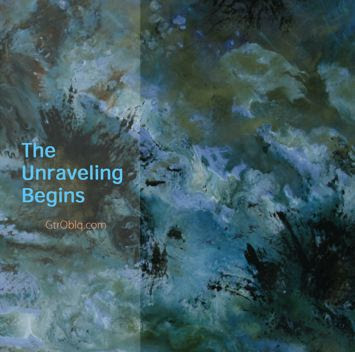 GtrOblq represents a confluence of forces within the world of avant guitar and experimental string music. From the wreckage of the Kronosonic movement, GtrOblq aims to focus the popular imagination upon the obscure universe of creative sound production, recording, and performance. The artists profiled at GtrOblq are among the finest composers, improvisers, loopers, microtonalists, noisicians, soundscapers, sound designers, fretless guitarists, and synthetic guitar wranglers.
"The Unraveling Begins" is a seminal compilation produced by fourteen of these varied, talented artists.
Number of Tracks: 14
Disc Duration: 43:27:02
UPC/EAN Code: 7202178000180
Shane's track, Bimbo Spam, is a collaboration with Aliensporebomb, who contributed all the bass tracks and a few guitars bits too. Preview it on myspace.
Available now at CDBaby.com!
Sunday, April 27, 2008
SD converts strat to fretless
So my really talented buddies over at gtroblq.com have managed to instill such a lust for microtones in me that I decided to take my beloved (albeit, cheap) Fernandes Retrorocket X and convert it into a fretless guitar. Now, I'm no luthier and depend heavily on folks who've already done this sort of thing to keep from screwing it up too badly.

Unfretted.com (Jahloon's famous site) has several DIY articles, including the one I mostly used (courtesy of Emre Meydan) to get this project accomplished. I also sought and received advice directly at the gtroblq.com forums.
I decided to post my photo journal of the process (complete photos without commentary available here), so that I might offer my own personal experiences with this relatively easy project.
BTW, I've been playing fretless now for just over a day and I love it. If you're a guitar playing veteran of many years like me, I recommend giving it a try. (Beginners might be a little more frustrated; I recommend starting on a fretted guitar or doing both at the same time).
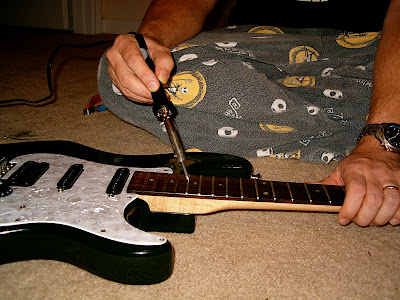
1. Heat up the fret with a soldering iron, carefully. I would do this until I saw glue seep out from beneath the fret.

2. Use fret pullers to gently remove the fret, starting at one end of a fret and working all the way to the other end. I experienced no significant chipping by doing this slowly, after heating each fret well.
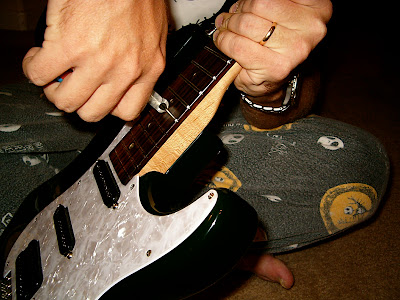
Close-up view of fret removal.
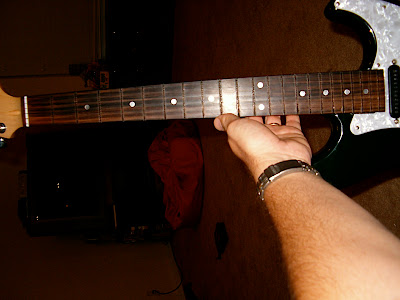
3. Defret complete!! That part was pretty easy.
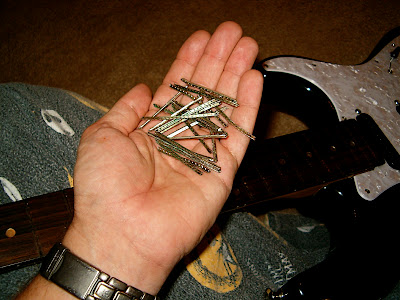
So long, frets!!!
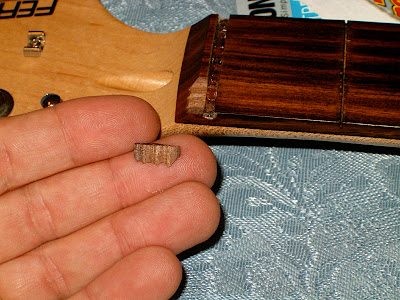
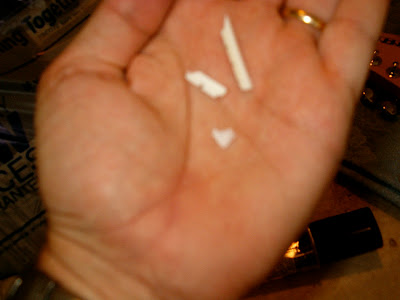
4. I used links provided by Chris Shaffer to explain how to remove the nut. Here was my first (and really only) problem. When I attempted to gently tap out the cheap, plastic nut, it broke into 3 pieces, and I chipped a small piece of rosewood out of the nut slot! Oops! Fortunately, the piece of rosewood was in one chunk which fit perfectly back in its place, and I had also bought a new graphite nut from Stewart-MacDonald!
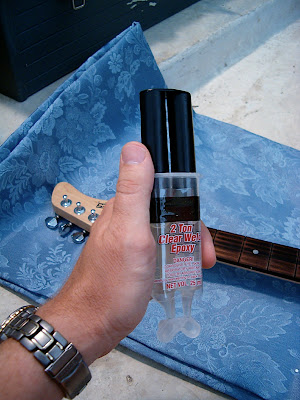
Enter the 2-ton, 60-min Epoxy! Not only would I use it to repair the nut slot, but I would also use it to fill the fret slots too!
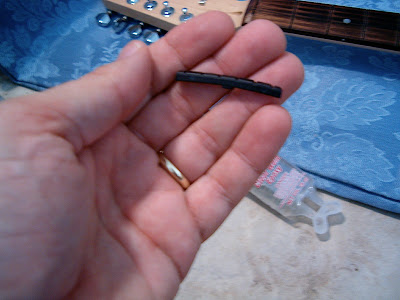
The new graphite nut I bought from Stewart-MacDonald (bought mainly to aid sustain but now quite necessary to finish the job, considering the original, broken nut)!
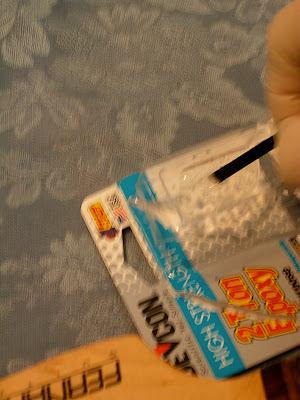
5. Mixing the epoxy THOROUGHLY! I should add that I used a razor to clean out the fret slots before proceeding!
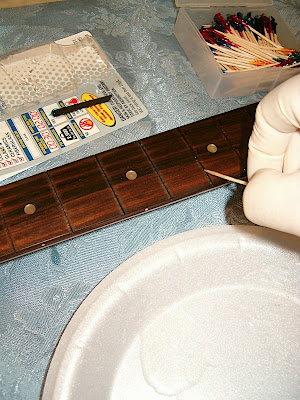
6. Using toothpicks to apply epoxy to the slots. This took a while, and I ensured a good application by running the tip of the toothpick along the slot until the epoxy flowed in and along it completely. I eventually used a styrofoam plate to prepare my epoxy (to keep from using old epoxy in subsequent slots).
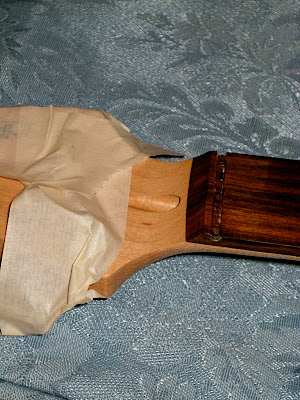
7. The chipped nut slot glued back together without any problems using the epoxy!
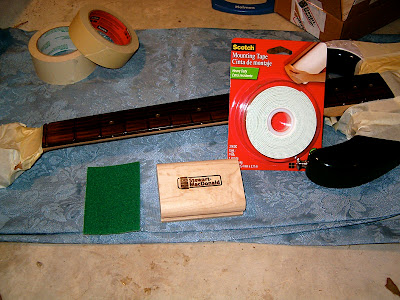
8. Guitar is taped up and fretboard ready for sanding, using grades of sandpaper from 80 to 320 or so. Note the 14" radius block purchased from Stewart-MacDonald and the double-sided tape.
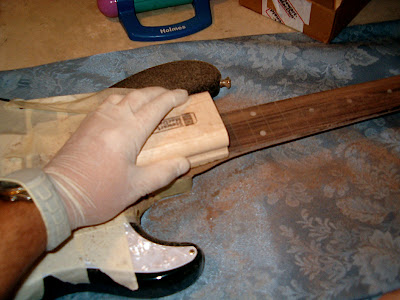
9. Sanding was the toughest part. First, I used the rough sandpaper (80) to remove all traces of excess epoxy. Once I could no longer see any epoxy, I progressed through the grades of sandpaper systematically, ensuring a smooth finish.

Wear gloves and other protection, because rosewood dust can be irritating.
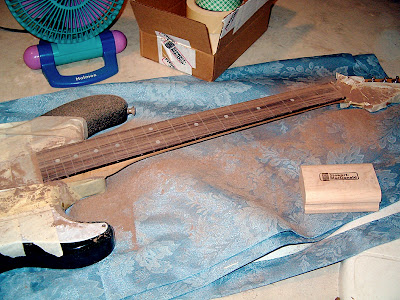
Progress! (Please be okay, strat!)
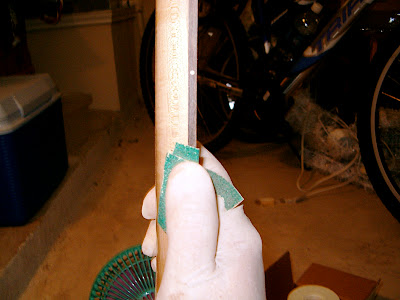
I also sanded the sides of the neck too, to remove excess epoxy.
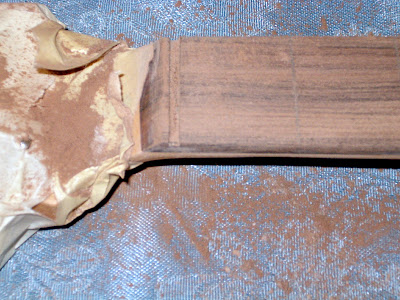
Sanding the outside of the nut slot made it hard to tell it had ever chipped.
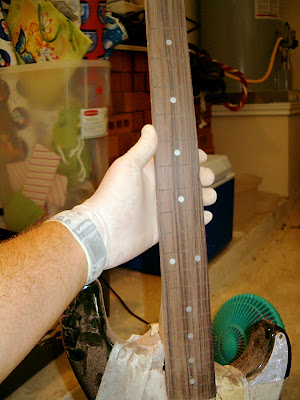
Voila! Sanding complete! It's a fretless!
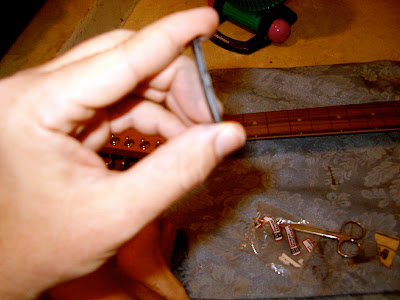
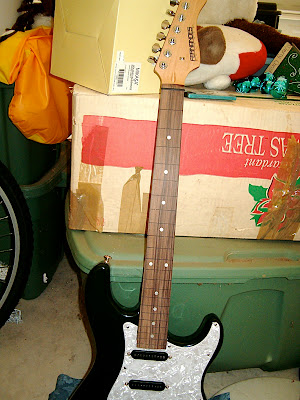
10. I removed all the protective masking tape and cleaned up all the rosewood dust (using a vacuum cleaner)! Next, I sanded down the bottom of the new graphite nut, and I lightly sanded the interior of the nut slot to remove any old glue. Then I installed the new nut and new roundwound strings (I didn't glue the nut in this time...I want to be sure it was not too high before gluing it). When I glue it with the next string change, I'll use a few drops of regular wood glue (so that I can remove it again easily if ever necessary).
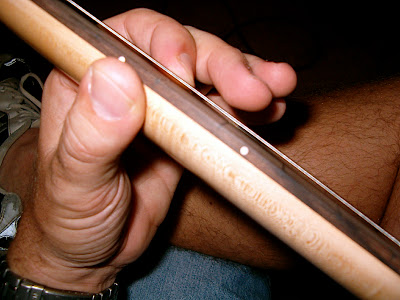
Playing my new fretless! It was love at first touch and first sound!
UPDATE: Here's a sample of what it sounds like!
Sunday, October 14, 2007
"Glass Shard Teeth" appears on Pirates' Week
The jazzy tune Glass Shard Teeth recently appeared on the Pirates' Week podcast in the episode for Pirates Week 10/14/07.

Thanks to Ragnar Daneskjold located in the Fook'n Ionosphere!
Wednesday, October 10, 2007
"The Dream" appears on iSPINIT Premium Podcast
SD's rock tune The Dream from the album Transduction Euphony recently appeared on the incredible iSPINIT Rock Podcast in episode 005.

Host Daniela Baldean stated:
I'm going to leave you with Sonic Deviant, which is actually Shane Hendricks. I was very intrigued when I heard Shane for the first time; he is fresh and very current. He plays all sorts of music, including jazz, rock--very experimental. So enjoy.Thank you Daniela and iSPINIT for the play!
Monday, October 01, 2007
SD appears on Help Andy Buy A Mac
Glass Shard Teeth from the album Transduction Euphony appeard on Relax Podcast #22 from HelpAndyBuyAMac, which also features the podcast X-Pat Radio. SD appeard on X-Pat previously.
Thanks for the play, Andy!
Saturday, September 22, 2007
New "Sunday Jam" video posted
Shane has posted a new video entitled Miscellaneous Sunday Jam on youtube.com. This is just a little guitar improv in one take, complete with errors, bleeps, and bloops. Hope you enjoy it.
Friday, June 15, 2007
String Skipping and Theme/Variations
I posted my first video on youtube.com; it's a sputtering, quasi-instructional-promotional video describing how I used string skipping and the baroque method of theme and variations to create the tune It's A Little Sickness from Transduction Euphony.
The tablature is a little tough to read on this compressed version of the video, so I'm including links here to the tablature:Hope you enjoy it and get something out of it. You can check out the recorded version of It's A Little Sickness on myspace.
Monday, March 05, 2007
Transduction Euphony RELEASED!
SD's new album,Transduction Euphony, is finally out after 4 years of toil and tribulation. You can get your copy on CD by visiting CDBaby.com. It will be available in the coming weeks on several online outlets for paid download, including iTunes.

Transduction Euphony is a record featuring 24 mostly instrumental tracks at a total run time of approximately 1 hour that will appeal to the rock, jazz, and avant-garde music enthusiast. If you enjoy guitar playing, music, and art from the likes of Frank Zappa, Steve Vai, John Scofield, BMR3000, Neil Haverstick, Dan Stearns, Marco Oppedisano, Ken Rubenstein, Infinite Ego, and other experimentally minded artists, you'll probably enjoy this record.
Featuring special guests artists DAVID SLACK (aka BMR3000 on bass) and SCOTT SIMMERMAN (on keys) on the jazz number, Glass Shard Teeth.
Additionally, the Sonic Deviant Official Web Site has been updated heavily. New scores have been added, as well as a new Press and Praise page, featuring encomia from many of Shane's influences.
Sunday, February 04, 2007
Named to "Critically Overlooked" on iCompositions
jdwyer05's "Criminally Overlooked" Music Recommendations on iCompositions, featuring special guest contributor becwil, named Sonic Deviant to the list of "Critically Overlooked." This list was sent out via the iCompositions Newsletter dated February 3, 2007, and it appeared in the forums of the website. becwil begins by saying:
I love to listen to music. I love to share my enthusiasm with other people. So, when Julian approached me to write my take on The Criminally Overlooked, I immediately thought about the artists here whom I have found and love that perhaps are a bit under the radar. Because I especially like the more edgy side of musical exploration, I will, today, list some of those artists I personally keep my ears on. This is not an all inclusive list, for I want to keep this brief, nor is it in any order other than as I read down my iTunes iComp playlist. I leave it up to you as to how far you explore each of these artist's catalogs.Later, he talks specifically about the music of Sonic Deviant:
There's some Zappa influence, admittedly so, and sonicdeviant plays to the beat of his own drummer, all puns intended. In-your-face. Crappy Products knocks your teeth out. While I Frade Errpains is a bit more friendly. A bit.Thanks jdwyer05 and becwil for the mentions. If you visit my page there, you can browse my list of favorite artists on iCompositions. There are many talented folks over there!
Wednesday, October 18, 2006
PSN listener comments on "Feline Demise"
Subscribe For Free Now!
A few PSN listeners have emailed some really nice comments to Big Al Wagner and Mike Big Honey" Bolan over at Project Studio Network regarding their review of my tune, Feline Demise, in Show #39.
In Show #40 at 34:30, Dave Criddle from Home Recording Odyssey sent some nice comments and an appropriate criticism regarding the lack of a strong bass instrument in the tune:
"Hey, tell Shane Hendricks I really enjoyed his song. Like a strange siren, I kept being drawn to it. I actually rewound and listened to it three times."
In Show #41 at 39:24, Nick Dodson had some really nice comments too:
"Not only were there Zappa-esque allusions, but there's also references to Captain Beefheart."

Friday, October 13, 2006
Shane gets a mention on IHR
Inside Home Recording's Neat links for October 12:

Derek from Inside Home Recording makes a mention of the Feline Demise review that appeared on PSN Show #39.
Featured on X-Pat Podcast!
Shane's older tune East Wind Blows West was featured in episode 58 on the X-Pat Radio podcast via podshow.com. This happened within hours of posting the music, so thanks X-Pat! 
Monday, October 02, 2006
PSN reviews "Feline Demise"
Project Studio Network Podcast #39:
Shane's tune, Feline Demise (from the upcoming CD Transduction Euphony), is reviewed by the guys at the Project Studio Network podcast in Show #39. The review is located at 39:36, but you'll want to catch all the other great information within the podcast if you're a home recording enthusiast.
Tuesday, September 12, 2006
Web Presence updated!
Be sure to check the changes to all the sites on the web, starting with sonicdeviant.com. My Space has been updated as well. The changes are in anticipation of finishing my next CD, Transduction Euphony.
I'm working hard on the next CD, but grad school takes precedence most of the time. I've posted some of the tunes from the forthcoming project at the sites listed above. Also, check out the awesome video Leo Alves Vieira put together for Mutation p53.
Wednesday, May 31, 2006
Lot's going on...(Rubenstein review)
I've revamped the web site quite a bit. I'm trying to decentralize as much as possible to allow easier maintenance of the site; for example, I've started moving my links to del.icio.us to allow me to share and update them easier, and I've started hosting my images at .Mac (also allows easier updating). News will now be mostly through this blog and on myspace: Neil Haverstick and other guitarists from around myspace and kronosonic posted some nice comments over at my myspace site.
I met a bunch of great guitarists, musicians, composers, and artists over at Kronosonic at the invitation of friend and experimentalist Dan Stearns.
I also finally met Ken Rubenstein, a terrific experimental guitarist who has been around for years. I bought his CD, Invert and Transcend, and decided to write a review of it for CDBaby:
Ken is a pioneer in the genre that many of us have only recently come to know--that of experimentalism, especially as it relates to the beloved, popular stringed instrument we all adore--the guitar. Experimental music is not wholly constituted of just random noise (though that sort of aleatoric music has its rightful, valid position in the realm of experimentalism); Ken (and a few others like him in this relatively young anti-genre) has shown that such music takes talent, skill, and courage. They are treading sonic ground where no one else has dared walk for fear of being misunderstood or outcast. Unlike the "others" in the music industry that popular culture tries to cram down our throats as currency in art, Ken and his ilk are the REAL pioneers--the REAL artists. They should be on the cover of Rolling Stone--not the latest Brittany Spears reject (or whatever corporate invention happens to be popular at the time)."Invert and Transcend" offers a rich treasure from the first to the last cut. Unlike some experimental music that can be tremendously dissonant and sonically overbearing, this CD is acoustically painted and very approachable for the casual listener, as well as for the trained musician. At times sounding similar to Michael Hedges and at others undefinable, this work is a watershed auditory experiment. Ken has chops that any guitar nut will appreciate, but the music is the star here--his technique is tastefully employed only as a tool to relate the story.
Ken breaks the listener in easily with a short acoustic intro tune called "Yudawee Sang With Love and Joy." The song features some very nice guitar synth embellishments and short bursts of fat, distorted guitar.
"Smallest Words" opens with a nice, chirping koto motif, interwoven between the left and right channels. Then there is an abrupt segue into the acoustic guitar introduction, followed by powerful, conjoining bass and drums. A real treat awaits the listener, as soprano Wendy Parker beautifully sings the unique melody line. Ken likes odd meters, and you'll hear plenty of that here and throughout the album. This number reminds me a bit of Steve Morse from "High Tension Wires." The song is full of changes and turns, so there's no chance of boredom setting in.
The next cut is "Xin Gap Lan." Soft, droning, flute-like synths lead into a very beautiful, arpeggiated acoustic flurry. The material is very rich, flowing, and extremely non-repetitive. Ken sucks you in and takes you on a journey of texture and variation. Interspersed throughout the beautiful tune is an unintelligible spoken word track, and a tastefully delayed horn solo (possibly created via guitar synth).
One of my favorites is "A Man Called Whores / You're All Whores / Lost In All That I'm Not." Here, the listener is taken through more adventurous territory. The opening lines, spoken in Arabic by Ameer, set the tone for the tune, which has a very Eastern ethnic feel, with incredible string lines, odd rhythms, and snapping drum corps snare lines. The spoken Arabic at the front of the tune has an extremely rhythmic, almost argumentative cadence that defines the bedlam to follow. Then there is a chaotic, bizarre interlude of atonal bliss, which rounds back into less dissonant territory toward the end, revisiting the sweet singing of Wendy Parker.
"A Song for Paul" opens with spoken exclamations of terminal drug-induced delirium (I'm assuming of "Paul") and cascading acoustic guitar work. The tune is thick with ambience and underlying busy fretwork, and the rhythm section is spectacular, as it is throughout the recording. There is a very cool upward glissando appearing throughout the tune that translates the emotional richness of this work.
"Broms" is an excellent atonal acoustic piece with some gorgeous Metheny-esque guitar synth lines. At the top of the tune, doubled guitar and synth phrases busily duck and dodge (in pulses of 8) around a quickly paced bass line. A short middle section here encapsulates remarkable guitar synth solo work.
"Lament for St. Thomas of Cantebury" is a nice horn and string arrangement, full of interesting counterpoint. "Invert and Transcend" is another of my favorites on the CD. Here, as in other places on the CD, there is little in the way of static, reappearing ideas; Ken is constantly moving, cascading, driving, and flowing from place to place--rhythmically and melodically, asking us to come with him. Miss Parker's singing talents reappear again on this piece, with an unusual melodic line, and provide a transition into a rapid, tasteful ethnic guitar passage.
"Woe Be Unto Thy Tangible Soul Who Cares Not What's At The End of the Pole As Long As He Fills Your Tight Black Hole" may be one of the longest (and most tongue-in-cheek) titles ever dreamed into existence by an artist, but the musical ideas contained within betray the covert Freudian humor of the song's moniker. More pleasing, pulsing, masterfully composed and performed acoustic guitar, synth, bass, and drums are found within the left and right bookends of the piece. By this point, the listener wonders if Ken will run out of ideas. The music is experienced with a belief that he certainly is conjuring it all at will. Midway through the approximately six-minute work is a staggering, traipsing guitar breakdown, replete with wailful string lines.
The last piece, "Beatrice Foley (for Charles Rosenberg)," is a short, mournful, slow work that initially starts with lightly tinkling piano lines, which, at first, seem to be trying to convey a melancholy narrative. Joining in toward the end are interesting synth bloops and, possibly, a guitar lightly feeding back in the background. A nice, soft, cushiony ending to a terrific project.
Ken is one of the great talents and pioneers of experimental music and guitar--a new realm of musical exploration also championed by such great artists as Neil Haverstick and Dan Stearns. This album is a must-have if you're sick of the "popular garbage" or "wannabe popular garbage" that pervades most Western music. As a matter of fact, just check out kronosonic.com to meet the REAL undiscovered talents of creative guitar and experimental music and art. These are the guys I look up to musically; they're real, talented, approachable, and nice folks too. Ken and others like him are the patriarchs of this genre--this anti-genre.Sunday, February 26, 2006
Now on myspace.com
Be sure to check out:
http://www.myspace.com/sonicdeviant
Two new songs are on there from the upcoming album! Have fun...
Saturday, May 07, 2005
Stick Man and Dan
 I just received a terrific CD, Stick Man, from a good friend of mine, guitarist Neil Haverstick, out in Colorado. One of the many tremendous attributes setting Neil apart from the ocean of competent, fervid guitarists out there is his use of microtones. Neil doesn't typically dabble in the ubiquitous 12-tone realm that most of the rest of us are trapped in; he takes an octave and, instead of dividing it evenly into 12 steps as is the prosaic Western way, he splits it into 19 or 34 equal divisions--hence the label microtones. The resulting music can be very challenging to the banal, jaded listener unwilling to tramp unfamiliar, enigmatic sonic ground. This music can sound out of tune, even to the most highly-trained, educated musician fancying herself tolerant of new or different things.
 I'm personally not so jaded in my own listening that I find his non-12-tone music offensive to the ears. Actually, I find it quite refreshing, and I find his exuberance and enthusiasm in its perpetuation and promotion inspirational. I've also read his book, The Form of No Forms, and found it a staggering instructional tool, advancing a new way of learning to understand, compose, and play music. Come to think of it, being the eclectic composer and artist he is, all of Neil's CDs are terrific listening digressions into tasteful, exceptional experimentalism. I've been a fan of his since 1993, and I first read about him when his music was reviewed in Mike Varney's Spotlight column in the December 1985 issue of Guitar Player magazine. At that point I had been playing guitar not even one year, but I remembered how cool he looked holding his ES-335 with the Yin-Yang emblem prominently adhered to the guitar's body; Neil was no posing shredder like the other chaps in Varney's column, trying to convince the magazine's readership he was the next incarnation of Yngwie Malmsteen--all the rage back in those days. It was that review that led me 7 years later to contact Neil and purchase his book, The Form of No Forms. From there we became friends, exchanging our latest projects and occasionally phoning and emailing each other. Since that 1985 review, Neil has appeared in numerous magazine reviews, has played with many prominent, renowned musicians, and has been praised by many of the same. He's among those I count as a musical influence.
 Neil introduced me to another master experimentalist named Dan Stearns, who likewise has been honored by many of the same publications that wrote about Neil. I could use many of the same encomiums I listed above and apply them to Dan without inaccuracy. He's just a plain nice guy with extreme loads of talent. Dan plays a fretless guitar and invents his own forms of musical notation to address the microtonal systems he employs. Another really cool thing about Dan is his use of polyrhythms, which is another realm of modern music that can confound all but the most adventurous auditory spirits. Frank Zappa and Steve Vai, two of my other influences, are (in the case of Frank--were) huge proponents of polyrhythms, where you apportion base elements of one meter into odd tuplets ad infinitum. Dividing a quarter note from 3/4 time into 5 sixteenth notes with the last sixteenth further subdivided into 3 thirty-second notes would be a sample polyrhythmic occurrence. Clearly all but the most technically talented of us can conceive and, much less, accurately play such forms, but Dan can do this stuff blind-folded. His guitar playing sounds almost computer-like in its virtuosic, accurate rhythmic interpretation of these fast tuplets. He's got chops for days. I'm lucky; Neil and Dan are two guys I know personally who just happen to be big influences on my own music and my life. I think other guitarists would benefit by adding them both to their influences list.
So if you're interested in discovering some great, oft overlooked musical giants, visit Dan's and Neil's sites. Read about them and buy some of their music. Support them because they're the real pioneers out there. They're the Lewis and Clark of 21st Century guitar playing. These guys are doing it for the art...not to be the next pop sensation.
Subscribe to:
Posts (Atom)