Showing posts with label fretless. Show all posts

Sunday, January 04, 2009

Jahloon writes about Area 51 Debris

area_51_debris

Jahloon, fretless guitarist, GtrOblq denizen, and keeper of unfretted.com, has penned a nice article about how he acquired Area 51 Debris, a fretless instrument created by an accomplished GtrOblq luthier, and formerly owned by Infinite Ego; the instrument is also believed to have been used by Bofatron Sofasaurus on several recordings.

I had known about the instrument for some time, and like I mentioned, web-searches can turn up some intriguing stuff. My search found a picture of a guitar like nothing I had seen before, enigmatically named "Area 51 Debris".

At first I thought it had been made specially for Infinite Ego, a formidable instrumentalist.

He hosted an Internet site and forum, which went through several iterations, changing name, changing identity, but with a core of avant garde musicians varying from the obscure to the almost famous.

One day you could find them, join their conversation, and the next day they had jumped continent, to reinvent themselves on a new website. Some website names you might recognise; Kronosonic / Shred Like Hell / Cone of Silence / Negation Hoster and their latest incarnation www.GtrOblq.com

Additionally they were a very close knit crew, with limited membership, if you weren't a serious musician, or didn't turn up on a regular basis, you were history.

[From Area 51 Debris]

Sunday, June 15, 2008

SD assembles his Carvin Bolt-T kit!

I recently sold my beloved Ibanez JEM77FP, mainly because I never played it much; it was one of those guitars that I practically put on an altar in equipment-lust homage, obeying the commandments of some bizarre cultish ritual to which we musicians are occasionally subject. The problem for me is that I'm a player--I've never been good at collecting guitars. I do much better PLAYING good quality guitars that I don't mind putting a ding on every now and then. So I sold the JEM to a really nice guy in PA (who is already worshipping the JEM the way I did) and used the cash to buy two great guitars and modify a third.

First, I bought a used 2006 Fender American Deluxe in Montego Black; it's a great sounding and looking guitar that needed only minor setup. Then, I ordered the gear from Stewart-MacDonald to convert my Fernandes Retrorocket X (with Carvin electronics) into a fretless. And then, I ordered a Carvin Bolt-T kit with a classic tweed case.

Key word is "kit," for it needs assembly and adjustment. So, I figured that this would be harder than it looked. Well, the assembly was a breeze. The adjustment was more difficult, as this was the first time that I ever dared to touch the truss rod in a guitar. But I had no choice; there was a tremendous reverse bow on the neck after I got the strings on, so it had to be done.

I need to say a word about Carvin's increasingly poor customer service. I've been a Carvin customer since the mid-90s, and my main stage amp is a Carvin 200SXD (a powerful twin). When I bought the amp, my first one blew up and they immediately sent me a new one and even paid for return shipping (BTW, my Carvin amp is nearing a decade in age and still blasts heads off regularly).

Well, I just ordered a kit guitar (on 15 April) that required a basic paint job. Again, "kit" means that Carvin did not have to assemble it. It took an amazing 8 WEEKS TO RECEIVE THE GUITAR, even though the fellow on the phone told me 4 to 5 weeks!!! I could understand 8 weeks if I had ordered a fancy neck-through-body guitar with spectacular finish options, but this was a kit with the most basic paint job. I sent an email at 6-weeks asking for a status and received no reply. So I called at week 7 and spoke with someone; he took my number and said he would call the next day with a status, and he NEVER CALLED BACK. I didn't get too mad, as the guitar came in the following week. So be warned: Carvin seems to be having a customer service crisis at the moment.

I should add that the guitar has a few, minor cosmetic flaws, but nothing worth sending it back over. I'm very pleased with the quality of this instrument, especially considering that I plan to beat it to death over the coming decade. In short, I think it was worth the wait, though I think the wait was silly and unnecessary.

Anyway, here's a photo journal of the assembly process (more photos here).

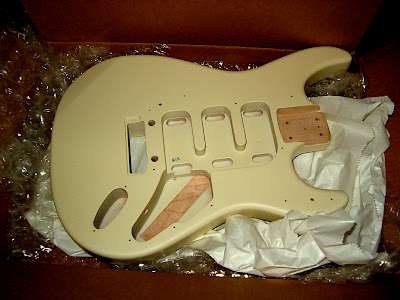
This is what the box looks like when you open it. Instructions right on top!

I had them paint my body for me...matte Classic White! (one small blemish in the finish)

The beautiful neck (one small flaw on the ebony fretboard - side piece facing the bridge).

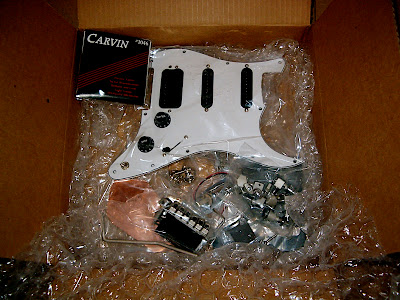
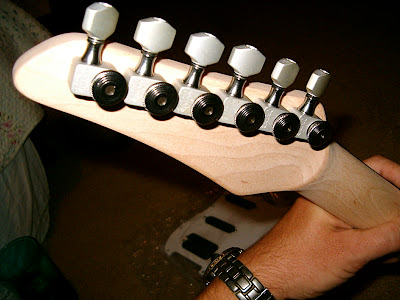
Pieces and parts! Awesome Wikinson tremelo and Sperzel locking tuners.

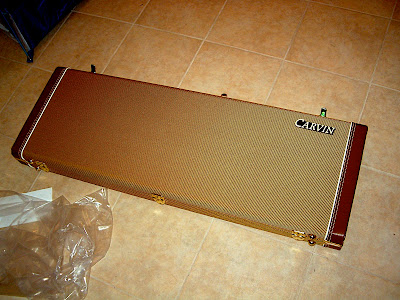
Classic tweed case (also made in USA).

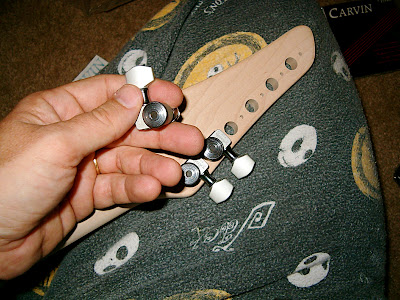
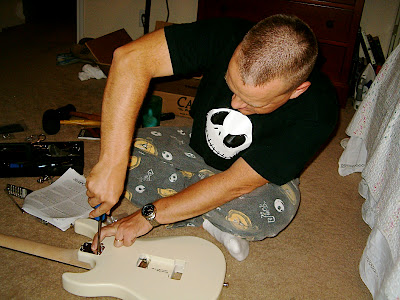
Installing Sperzels.

All installed!

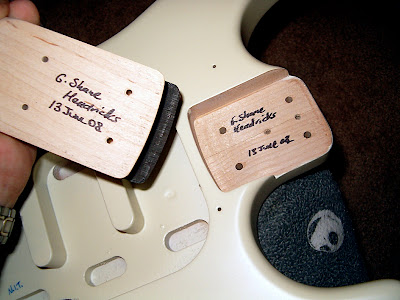
Had to make my inscription.

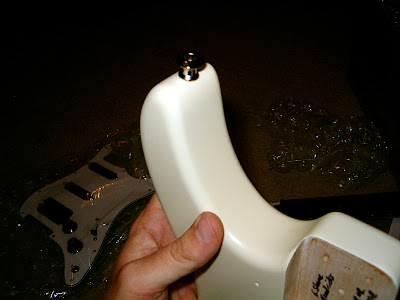
Installing the Dunlop strap locks.

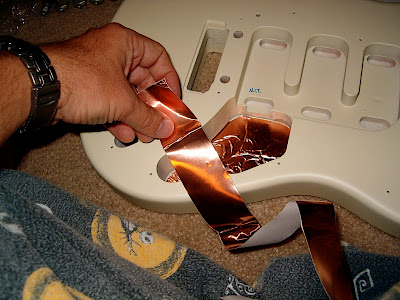
Cavity shielding...reminded me of the material they use on satellites and other space vehicles.

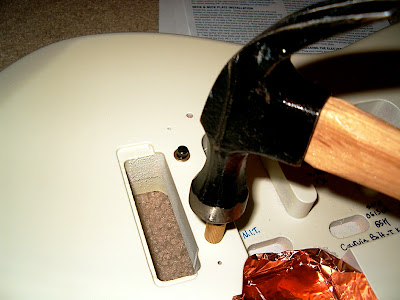
Nerve-racking part: Hammering in the tremelo posts.

Putting on the spring claw.

Installing the neck.

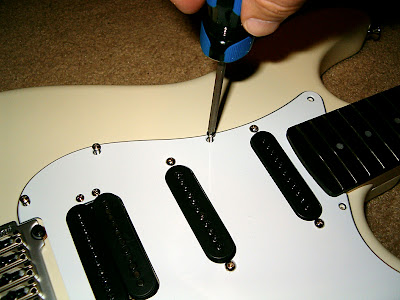
Pre-wired pickguard. No soldering required.

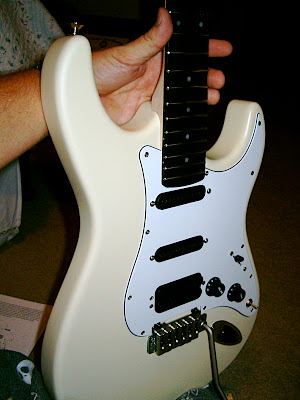
Voila! Now strings and adjustments.

My collection...the Fernandes fretless, Carvin Bolt-t, and Fender American!

Sunday, April 27, 2008

SD converts strat to fretless

Unfretted Link
So my really talented buddies over at gtroblq.com have managed to instill such a lust for microtones in me that I decided to take my beloved (albeit, cheap) Fernandes Retrorocket X and convert it into a fretless guitar. Now, I'm no luthier and depend heavily on folks who've already done this sort of thing to keep from screwing it up too badly.

Unfretted.com (Jahloon's famous site) has several DIY articles, including the one I mostly used (courtesy of Emre Meydan) to get this project accomplished. I also sought and received advice directly at the gtroblq.com forums.

I decided to post my photo journal of the process (complete photos without commentary available here), so that I might offer my own personal experiences with this relatively easy project.

BTW, I've been playing fretless now for just over a day and I love it. If you're a guitar playing veteran of many years like me, I recommend giving it a try. (Beginners might be a little more frustrated; I recommend starting on a fretted guitar or doing both at the same time).
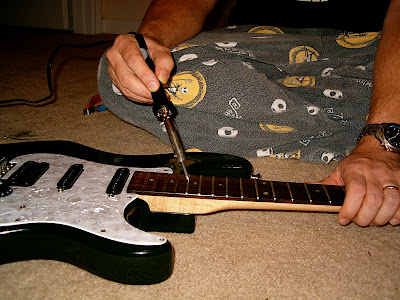
1. Heat up the fret with a soldering iron, carefully. I would do this until I saw glue seep out from beneath the fret.

2. Use fret pullers to gently remove the fret, starting at one end of a fret and working all the way to the other end. I experienced no significant chipping by doing this slowly, after heating each fret well.
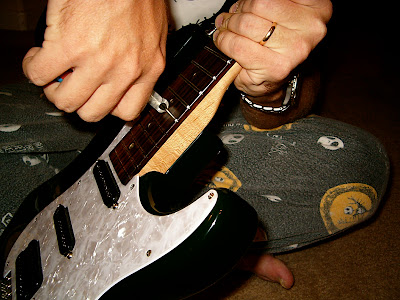
Close-up view of fret removal.
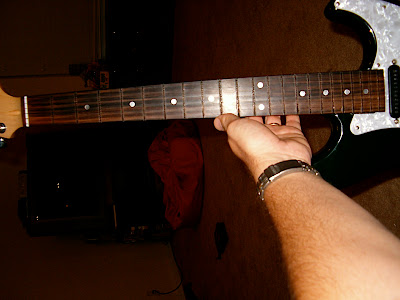
3. Defret complete!! That part was pretty easy.
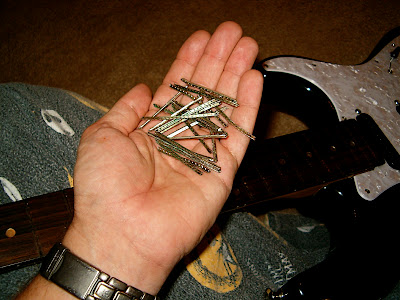
So long, frets!!!
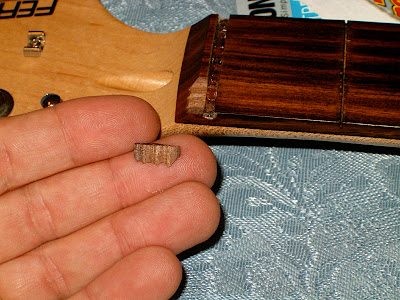
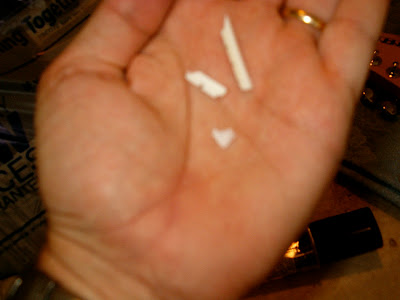
4. I used links provided by Chris Shaffer to explain how to remove the nut. Here was my first (and really only) problem. When I attempted to gently tap out the cheap, plastic nut, it broke into 3 pieces, and I chipped a small piece of rosewood out of the nut slot! Oops! Fortunately, the piece of rosewood was in one chunk which fit perfectly back in its place, and I had also bought a new graphite nut from Stewart-MacDonald!
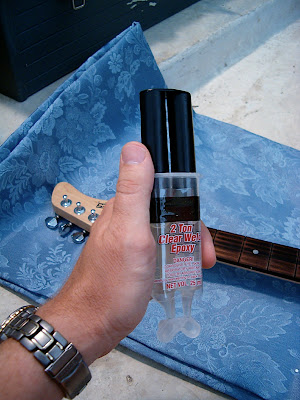
Enter the 2-ton, 60-min Epoxy! Not only would I use it to repair the nut slot, but I would also use it to fill the fret slots too!
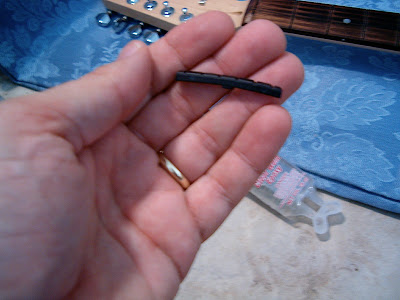
The new graphite nut I bought from Stewart-MacDonald (bought mainly to aid sustain but now quite necessary to finish the job, considering the original, broken nut)!
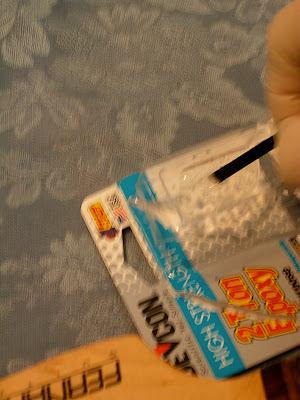
5. Mixing the epoxy THOROUGHLY! I should add that I used a razor to clean out the fret slots before proceeding!
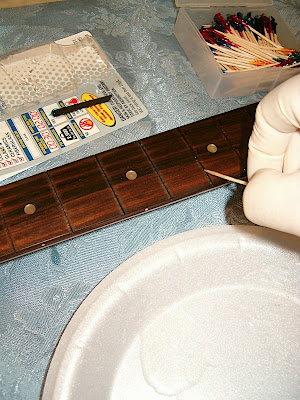
6. Using toothpicks to apply epoxy to the slots. This took a while, and I ensured a good application by running the tip of the toothpick along the slot until the epoxy flowed in and along it completely. I eventually used a styrofoam plate to prepare my epoxy (to keep from using old epoxy in subsequent slots).
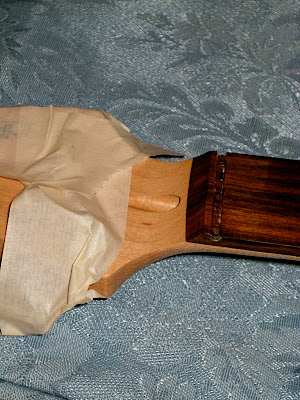
7. The chipped nut slot glued back together without any problems using the epoxy!
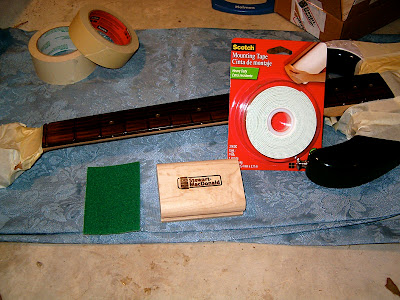
8. Guitar is taped up and fretboard ready for sanding, using grades of sandpaper from 80 to 320 or so. Note the 14" radius block purchased from Stewart-MacDonald and the double-sided tape.
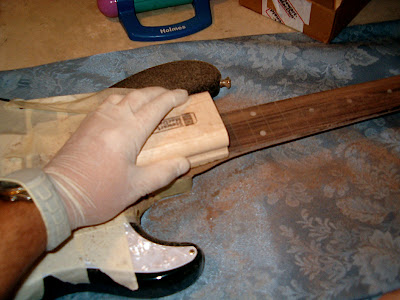
9. Sanding was the toughest part. First, I used the rough sandpaper (80) to remove all traces of excess epoxy. Once I could no longer see any epoxy, I progressed through the grades of sandpaper systematically, ensuring a smooth finish.
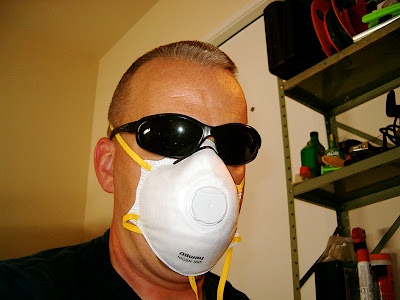
Wear gloves and other protection, because rosewood dust can be irritating.
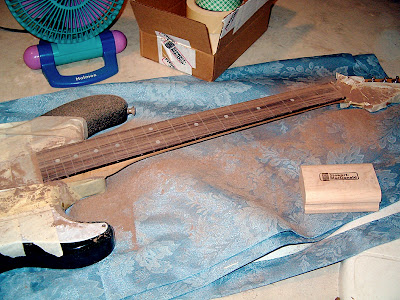
Progress! (Please be okay, strat!)
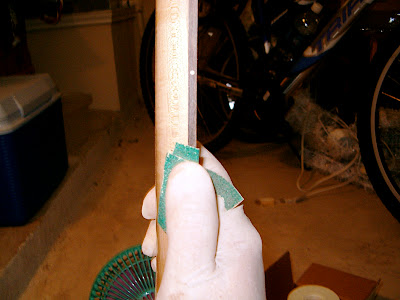
I also sanded the sides of the neck too, to remove excess epoxy.
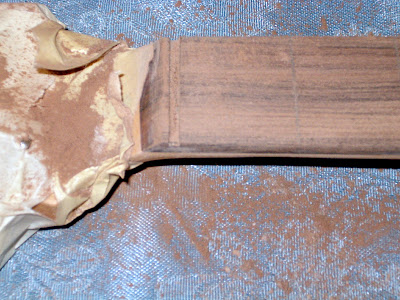
Sanding the outside of the nut slot made it hard to tell it had ever chipped.
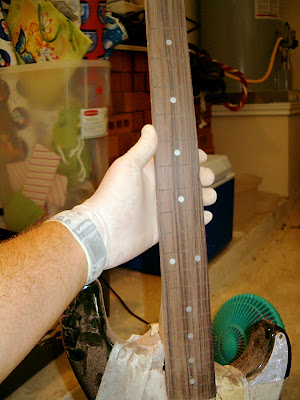
Voila! Sanding complete! It's a fretless!
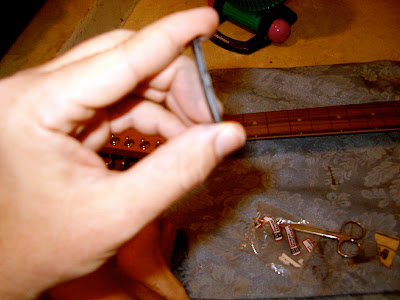
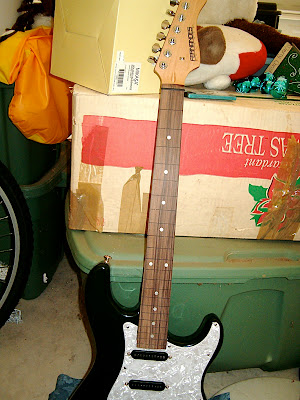
10. I removed all the protective masking tape and cleaned up all the rosewood dust (using a vacuum cleaner)! Next, I sanded down the bottom of the new graphite nut, and I lightly sanded the interior of the nut slot to remove any old glue. Then I installed the new nut and new roundwound strings (I didn't glue the nut in this time...I want to be sure it was not too high before gluing it). When I glue it with the next string change, I'll use a few drops of regular wood glue (so that I can remove it again easily if ever necessary).
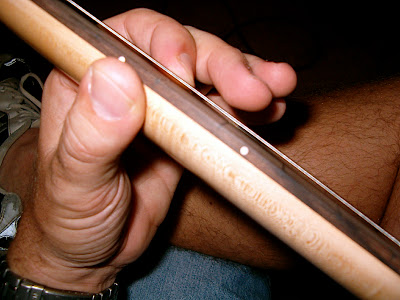
Playing my new fretless! It was love at first touch and first sound!

UPDATE: Here's a sample of what it sounds like!

Saturday, May 07, 2005

Stick Man and Dan

I just received a terrific CD, Stick Man, from a good friend of mine, guitarist Neil Haverstick, out in Colorado. One of the many tremendous attributes setting Neil apart from the ocean of competent, fervid guitarists out there is his use of microtones. Neil doesn't typically dabble in the ubiquitous 12-tone realm that most of the rest of us are trapped in; he takes an octave and, instead of dividing it evenly into 12 steps as is the prosaic Western way, he splits it into 19 or 34 equal divisions--hence the label microtones. The resulting music can be very challenging to the banal, jaded listener unwilling to tramp unfamiliar, enigmatic sonic ground. This music can sound out of tune, even to the most highly-trained, educated musician fancying herself tolerant of new or different things.

I'm personally not so jaded in my own listening that I find his non-12-tone music offensive to the ears. Actually, I find it quite refreshing, and I find his exuberance and enthusiasm in its perpetuation and promotion inspirational. I've also read his book, The Form of No Forms, and found it a staggering instructional tool, advancing a new way of learning to understand, compose, and play music. Come to think of it, being the eclectic composer and artist he is, all of Neil's CDs are terrific listening digressions into tasteful, exceptional experimentalism. I've been a fan of his since 1993, and I first read about him when his music was reviewed in Mike Varney's Spotlight column in the December 1985 issue of Guitar Player magazine. At that point I had been playing guitar not even one year, but I remembered how cool he looked holding his ES-335 with the Yin-Yang emblem prominently adhered to the guitar's body; Neil was no posing shredder like the other chaps in Varney's column, trying to convince the magazine's readership he was the next incarnation of Yngwie Malmsteen--all the rage back in those days. It was that review that led me 7 years later to contact Neil and purchase his book, The Form of No Forms. From there we became friends, exchanging our latest projects and occasionally phoning and emailing each other. Since that 1985 review, Neil has appeared in numerous magazine reviews, has played with many prominent, renowned musicians, and has been praised by many of the same. He's among those I count as a musical influence.

Neil introduced me to another master experimentalist named Dan Stearns, who likewise has been honored by many of the same publications that wrote about Neil. I could use many of the same encomiums I listed above and apply them to Dan without inaccuracy. He's just a plain nice guy with extreme loads of talent. Dan plays a fretless guitar and invents his own forms of musical notation to address the microtonal systems he employs. Another really cool thing about Dan is his use of polyrhythms, which is another realm of modern music that can confound all but the most adventurous auditory spirits. Frank Zappa and Steve Vai, two of my other influences, are (in the case of Frank--were) huge proponents of polyrhythms, where you apportion base elements of one meter into odd tuplets ad infinitum. Dividing a quarter note from 3/4 time into 5 sixteenth notes with the last sixteenth further subdivided into 3 thirty-second notes would be a sample polyrhythmic occurrence. Clearly all but the most technically talented of us can conceive and, much less, accurately play such forms, but Dan can do this stuff blind-folded. His guitar playing sounds almost computer-like in its virtuosic, accurate rhythmic interpretation of these fast tuplets. He's got chops for days. I'm lucky; Neil and Dan are two guys I know personally who just happen to be big influences on my own music and my life. I think other guitarists would benefit by adding them both to their influences list.

So if you're interested in discovering some great, oft overlooked musical giants, visit Dan's and Neil's sites. Read about them and buy some of their music. Support them because they're the real pioneers out there. They're the Lewis and Clark of 21st Century guitar playing. These guys are doing it for the art...not to be the next pop sensation.